Democrats Split on Trump’s Iran Strikes as War Powers Debate Looms
Lawmakers from the Democratic Party were united in calling Iran a threat but divided on what to do about it.

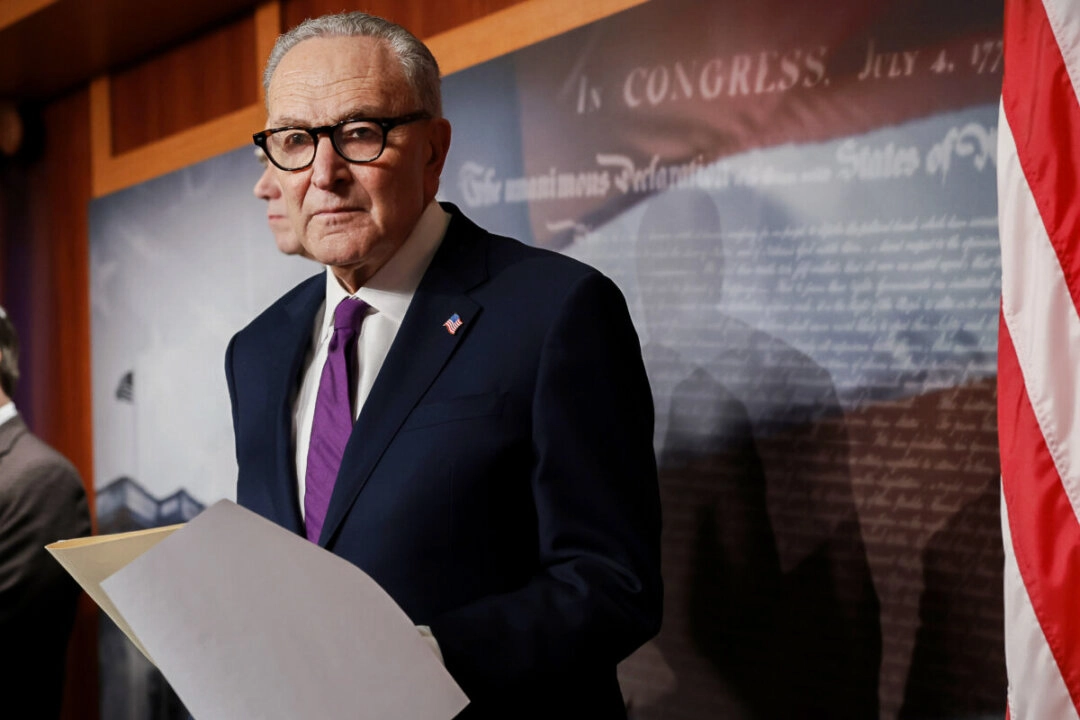
Senate Minority Leader Chuck Schumer (D-N.Y.) listens during a news conference on the Epstein Files on Capitol Hill on Feb. 26, 2026. Anna Moneymaker/Getty Images
U.S. Congressional leaders of the Democratic Party have mostly been quick to decry U.S. President Donald Trump and Israel’s joint operation in Iran over the weekend, which killed Iranian leader Ali Khamenei and other Iranian officials, while many other party members have been supportive.
Senate Minority Leader Chuck Schumer (D-N.Y.) said that in conversations with Secretary of State Marco Rubio, he has been clear that the Trump administration must be straightforward with Congress and the American people, saying that Iran “must never be allowed to attain a nuclear weapon but the American people do not want another endless and costly war in the Middle East when there are so many problems at home.”
“The administration has not provided Congress and the American people with critical details about the scope and immediacy of the threat,” Schumer said in a Feb. 28 statement after the strikes.
“Confronting Iran’s malign regional activities, nuclear ambitions, and harsh oppression of the Iranian people demands American strength, resolve, regional coordination, and strategic clarity. Unfortunately, President Trump’s fitful cycles of lashing out and risking wider conflict are not a viable strategy.”
On March 2, House Minority Leader Hakeem Jeffries (D-N.Y.) held a similar stance, saying that Iran was a “bad actor” that must be “aggressively confronted for its human rights violations, nuclear ambitions, support of terrorism,” and threats to allies in the region such as Israel and Jordan.
Jeffries said that, in his opinion, the Trump administration had “failed to provide any justification for these preemptive strikes.”
“We’ll continue to look for information that they owe the American people to suggest that there was intelligence indicating that Iran was prepared to strike the United States,” he told CNN News Central. “Nothing has been presented to justify what’s taking place up until this point, and the administration has an obligation to be able to prove that.”
Jeffries said that Americans want Congress and the president to focus on making their life better and more affordable, “not getting involved in another endless war in the Middle East that is going to end in failure.”
War Secretary Pete Hegseth disputed the “endless war” remark made by Jeffries and others during a press conference at the Pentagon, saying the Iranian campaign is not another endless war, such as the war in Iraq.
“This is not Iraq,” Hegseth said on March 2, speaking directly to U.S. military forces around the world. “This is not endless. I was there for both. Our generation knows better, and so does this president. He called the last 20 years of nation-building wars dumb, and he’s right. This is the opposite. This operation is a clear, devastating, decisive mission.”

He said there were three main points to the operation: destroy the Iranian missile threat, destroy the Iranian navy, and ensure that Iran doesn’t develop nuclear weapons.
“This is the generational turning point America has waited for since 1979,” Hegseth said. “And since the rudderless wars of hubris my generation, our generation endured. Don’t listen to the noise—just stay focused. Our commander-in-chief is steady at the wheel.”
Sen. Mark Kelly (D-Ariz.) said in a March 1 post on X: “The Senate needs to vote immediately on Tim Kaine’s War Powers Resolution. I’m voting yes, because it’s clear that Trump has no plan to avoid escalation into a wider conflict that puts more servicemembers in harm’s way.”
Kelly also said on NBC’s Meet the Press with Kristen Welker on March 1 that it was “a good thing” that the Iranian leader and some of those around him were gone but that Congress needed more information.
“Hope is not a strategy,” he said. “We’ve got to have a plan here. I mean, what is the strategic goal? And how do we achieve it? And my job here in the United States Senate is to make sure that this administration has a plan and doesn’t put Americans, especially U.S. servicemembers, at further risk.”
As of midday on March 2, four U.S. servicemembers were reported to have been killed in the operations.
Rep. Josh Gottheimer (D-N.J.) applauded the decisive action taken by Israel and the United States but said the president must comply with the War Powers Act and brief Congress on the strategy ahead.
‘With [Khamenei’s] elimination, the Iranian people now have a historic opportunity to reclaim their country from decades of repression,” Gottheimer said in a post on social media. “What comes next is critical. We must advance lasting peace for the region, protect our allies, and stand with the Iranian people.”
Rep. Greg Landsman (D-Ohio) said he supported the strikes and would not support a bipartisan war powers resolution by Reps. Ro Khanna (D-Calif.) and Thomas Massie (R-Ky.) later this week, noting that it would be akin to abandoning allies in the region.
“The U.S. is destroying Iran’s missiles and bombs to stop them from taking more lives,” Landsman said in a Feb. 28 statement. “These strikes are targeting military infrastructure—with warnings to Iranian civilians to take shelter away from these military targets. If it wasn’t for the regime, the region may very well know peace.”
Both the House and Senate had drafted war powers resolutions before the strikes began on Feb. 28, and lawmakers are expected to debate them this week. The resolutions would restrain the president’s military campaign in Iran unless the administration wins formal congressional authorization, a vote the administration never sought.

Sen. Tim Kaine (D-Va.) has led the bipartisan Senate effort alongside allies in the House, where Khanna and Massie have demanded Congress convene for a public vote. Massie, a Republican, blasted Trump’s own campaign slogan, saying that the strikes are “not ‘America First.’”
Even if a resolution were to pass the narrowly divided Congress, Trump would likely veto it, and neither chamber appears to have the two-thirds majority needed to override that veto. An earlier Senate effort to halt Trump’s actions after last summer’s strike on Iran also failed. Supporters say the roll call vote would put every member on the public record.
Rep. Tom Suozzi (D-N.Y.), who co-chairs the bipartisan Problem Solvers caucus, said in a post on X that the president did brief the bipartisan House, Senate, and Intelligence Committee leadership prior to the strikes as required and committed to ongoing updates as required.
“I agree with the President’s objectives that Iran can never be allowed to obtain nuclear capabilities,” Suozzi said. “The President must now clearly define the national security objective and articulate his plan to avoid another costly, prolonged war in the Middle East.”
Sen. John Fetterman (D-Pa.) said in a post on X over the weekend that the president had done “what’s right and necessary to produce real peace in the region.”
As Congress returned to Washington on March 2, he had a more critical message for his party.
“Every member in the U.S. Senate agrees we cannot allow Iran to acquire a nuclear weapon,” Fetterman wrote in a post on X. “I’m baffled why so many are unwilling to support the only action to achieve that. Empty sloganeering vs. commitment to global security—which is it?”

The Democratic National Committee (DNC) said in a statement that the action was contrary to Trump’s “pro-peace” and “America First” 2024 campaign promises.
“Make no mistake: the Iranian regime has sanctioned terrorism, and undermined democracy and the human rights of its people,” DNC Chair Ken Martin said in a statement. “But our nation deserves better than a government that shoots first and asks questions later. Americans do not look fondly on presidents that force us into deadly, expensive, endless conflicts.”
Their counterparts at the Republican National Committee (RNC) said that Trump had proven “once again” that “America’s warnings are backed by overwhelming strength.”
“The days of the United States tolerating threats from America’s enemies are over,” RNC Chair Joe Gruters said. “While the Obama administration gave billions to the Iranian regime, empowering the world’s leading state sponsor of terrorism, President Trump is protecting America through decisive action.”
The Associated Press contributed to this report.













Post Comment