Australian Families Spending Over $100,000 on Schooling for Every Child
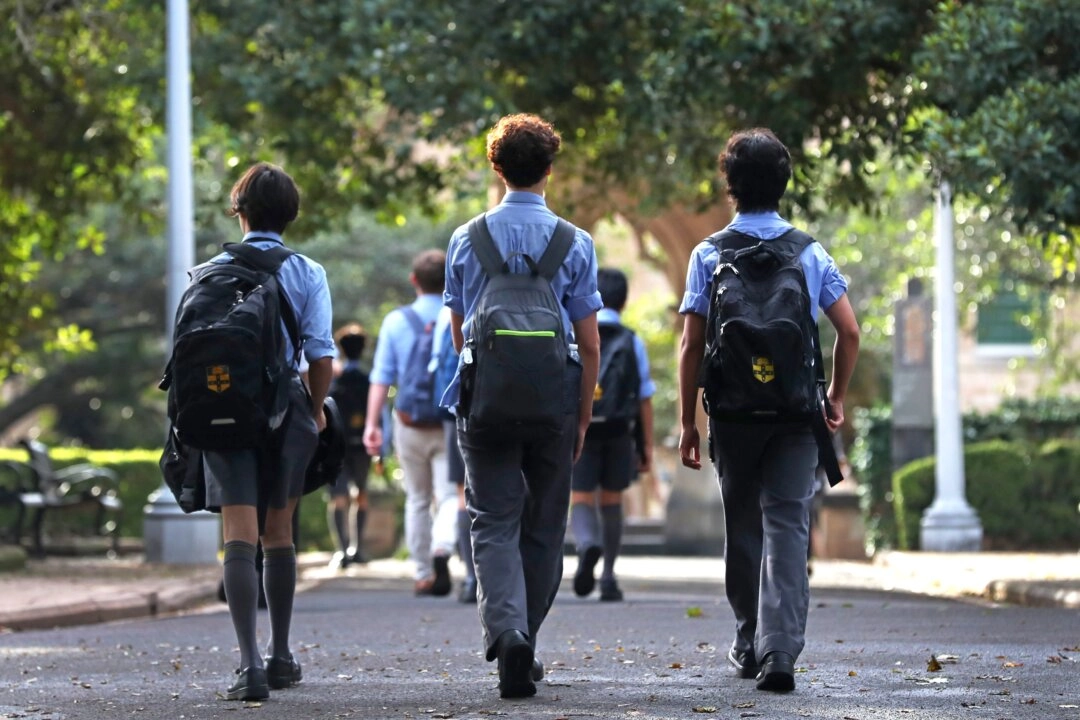
Families in major cities who have a child starting school this year will pay $113,594 for a government education, with regional and remote areas slightly less.

School students make their way through the Sydney central business district (CBD) in Australia on March 26, 2025. Lisa Maree Williams/Getty Images
Families across Australia are struggling to pay the rising cost of schooling, with 33 percent resorting to credit cards and more than half saying they rely on others, including grandparents, to cover the cost.
Many are working longer hours, having fewer holidays, and trying to save on expenses by buying second-hand school uniforms, make a laptop last longer, and spending less on musical instruments and camps.
And 45 percent of parents even said they are considering having fewer children as a result of the cost of raising and educating a child today.
Those are among the results of research conducted by school finance group Futurity, which gathers school fee data from Australia’s curriculum authority and interviews 2,500 parents about their spending and lifestyle choices.
A family living in a major city with a child who starts school in 2026 will, over the next 13 years, pay $113,594 to send them to a government school, $247,174 for Catholic schooling or $369,594 for an independent school.
Those living in regional and remote areas will pay slightly less: $100,395 for a state education, $223,874 for Catholic, and $230,144 for independent schools.
Melbourne was Australia’s most expensive capital city in which to attend a public school, costing $121,202, and an independent school, which will run to $435,902.
Brisbanites will spend the most for a Catholic education at $273,494, while Western Australia is the priciest for independent regional and remote schools at $275,639.
The least expensive places to attend a state school are regional and remote Western Australia, Tasmania and the Northern Territory, which are all under $100,000.
| Location | State school | Catholic school | Independent school |
| National city average | $113,594 | $247,174 | $369,594 |
| National regional and remote average | $100,395 | $223,874 | $230,144 |
| Cities | |||
| Melbourne | $121,202 | $247,999 | $435,902 |
| Sydney | $106,567 | $223,919 | $401,512 |
| Brisbane | $120,486 | $273,494 | $423,378 |
| Adelaide | $111,630 | $249,830 | $304,997 |
| Perth | $102,600 | $253,324 | $331,525 |
| Canberra | $111,131 | $211,493 | $322,939 |
| Regional and remote areas | |||
| New South Wales | $94,849 | $209,111 | $233,853 |
| Victoria | $103,629 | $216,975 | $245,793 |
| Queensland | $108,647 | $244,714 | $239,085 |
| South Australia | $95,027 | $233,687 | $242,163 |
| Western Australia | $92,287 | $230,319 | $275,639 |
| Tasmania | $73,273 | $196,121 | $220,326 |
| Northern Territory | $66,672 | $130,575 | $162,820 |
The fees charged by state schools make up only 13 percent of the total for metropolitan areas and 5 percent for the regions, with the remainder being spent on other costs, including outside tutoring, transport, school camps and uniforms.
Despite the cost burden, families value education, with nine in 10 saying it is important for their child to thrive in life, Futurity’s Sarah McAdie said.
“(They) are prepared to make sacrifices in order for their child to access the education that the parents choose and value for their child,” she said.
But parents have been reducing their spending on other areas as concern increases about Australian schools being fully funded, according to the Australian Council of State School Organisations.
The organisation’s interim chair, Peter Garrigan, said, “When the household budget is under pressure, things like sport and camps and upgrades are the first things that are scaled back.”
He said the real test is whether every child can participate fully without money being a barrier. “Australia’s society should be able to support everyone to do that,” he said.
Sixty-three percent of students are enrolled in government schools, followed by 20 percent in Catholic schools and 17 percent in independent schools, according to the Australian Bureau of Statistics. For 52 percent of the parents in the Futurity study who were unable to access their preferred school cited cost as the barrier.







Post Comment