The Solar Chase
Aurora Fever: Chasing the Sky as the Sun Goes Crazy
Last year was the first time I witnessed a full-blown extravaganza of northern lights. The aurora borealis gave a spectacular show over the Great Lakes in 2024, and I was lucky to be there. It was everything you could imagine: awe-inspiring, exhilarating, and divine.
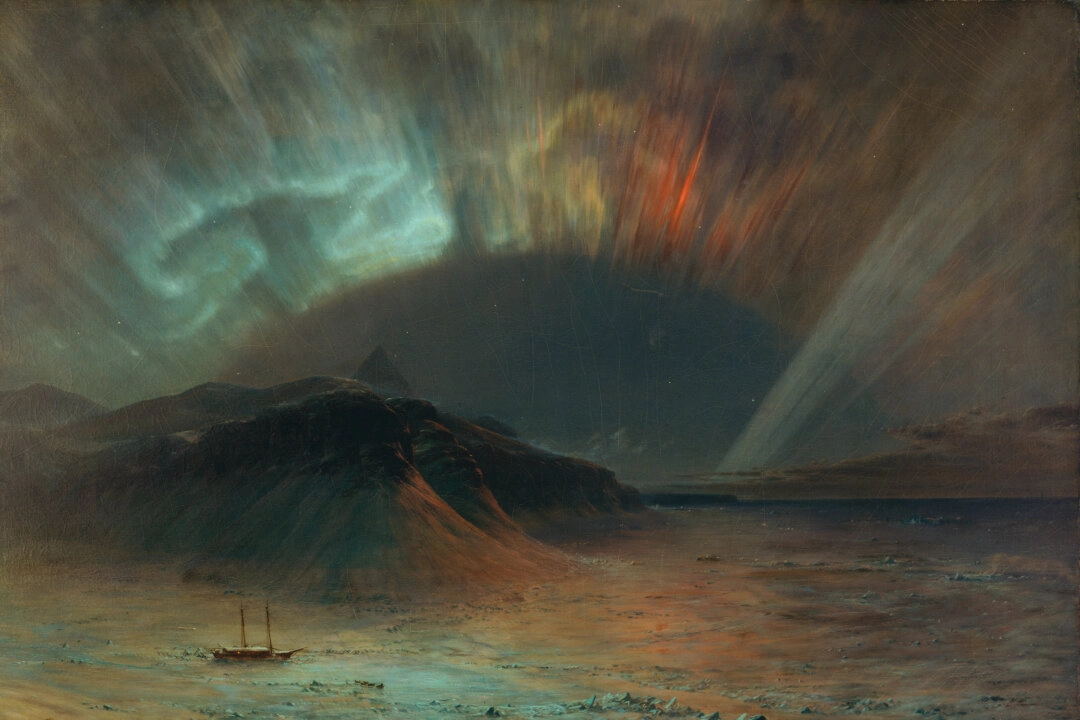
The lights seemed to emanate from the horizon, which made me recall a picture I’d once seen depicting a mythical moment from an epic poem. We find the hero Kalevipoeg sailing a silver ship to the edge of the world, where he and his companions encounter a celestial omen:
(Adapted from Kalevipoeg, Canto XX, Kreutzwald (1861)
It’s a beautiful description, yet I’ve always found my own childhood version just as magical in its simplicity: the northern lights framed as sunlight bouncing off Arctic icebergs. Even now, grown older and wiser, I can’t help but think that still might be a plausible explanation.
Hunters and Chasers
You may be surprised to learn how many aurora apps there are to pick from. I had chosen to download My Aurora Forecast & Alerts, along with 5M+ other people. As luck would have it, the aurora alarm went off as I was already headed north—less than an hour from the shores of Lake Ontario. It was a moonless night, and I continued my drive to a place I’d known since childhood—a spot so familiar I could walk it with my eyes closed.
Nearing the shore, I could see the flicker of red taillights. Apparently, I wasn’t the only skywatcher drawn to this vantage point. It was here that I first met them—the “hunters” and the “chasers.”
Some were pointing their phones skyward, oohing and aahing; others were hastily fumbling with tripods and lenses. Some sat staring in solitary awe; others embraced to share the wonder.
I struck up a conversation and learned that folks were chatting on Facebook—part of the “aurora hunters” group for our area. You can join a group and receive a notification when someone posts “it’s go time!” It’s a 21st-century version of a flash mob, and might even be better than having an app alert you. Houses and apartments empty out as hunters run to their backyards and chasers jump in their cars to rendezvous at dark sky lookouts. Soon, updates and photos start pouring in. If you wait, you can let the more adventurous ones report back before you strike out on your own.
A quick search finds aurora hunters and chasers coming together from around the world, from Connecticut to Iceland and Wisconsin to Ireland.
The Naked Eye vs. The Camera
The first thing you learn when viewing an actual aurora event is that what you see with the naked eye isn’t what you see through the phone or camera lens. I was looking up at sheets of white light dancing against a black sky, but people’s phones were showing that same sky filled with magenta and neon green. I was perplexed.
It turns out your eyes don’t have the “exposure time” to see what’s really there, but a good camera doesn’t fake the colors—it reveals them. So it’s not a false interpretation of what you’re seeing; it’s a truer one.
And when you get above Earth’s atmosphere, it gets even better.
Astronauts on the International Space Station are able to see auroras above Earth’s atmosphere, so they see bright, steady lights in full color. NASA astronaut Don Pettit described it this way, “We were not flying above the aurora; we were flying in the aurora.”
“It looked like @Space_Station had been shrunk to some miniature dimension and inserted into a neon sign,” he posted on social media in October 2024. Pettit captured yet another rare blood-red aurora in a stunning YouTube video.
The Science Behind It
The next thing you might wonder is why you’re more likely to see colorful auroras in Fairbanks, Alaska, than, say, New York. Let’s just say it has everything to do with Earth’s magnetic geometry.
Fairbanks sits close to the auroral oval—a shifting ring that encircles the geomagnetic North Pole where auroras occur regularly and intensely. A matching oval exists around the South Pole for the Aurora Australis (yep, they are super active right now too; ask the hunters and chasers in Australia and New Zealand.) These are the two regions where charged particles from the sun are funneled by Earth’s magnetic field into the atmosphere, creating spectacular displays of light.
The farther you are from the auroral ovals, the less frequently and less vividly you’ll see them. But during a particularly strong solar storm, nearly everyone gets a chance to see a splash of color across the sky.
The Experience of a Lifetime
At the aurora event in 2024, I initially saw sheets of white lights waving across the sky. Eventually, however, I saw neon green, magenta, and other colors with the naked eye. Though the colors seemed a bit muted, they were still dazzling.
I also saw pillars—vertical columns of light that seemed to shoot straight up from the horizon. But the most amazing thing was the flashes overhead. “Look up!” I said to my fellow hunters. They seemed reluctant to tear themselves away from their equipment, but soon they were all looking toward the zenith.
The only way to describe the flashes is to say it looked like God was turning a flashlight on and off behind a frosted glass door. It wasn’t a phenomenon to be photographed; it was an experience to be felt. No one was trying to get pictures anymore; they were staring at the sky in stunned silence. Whispers of “wow” and “What is that?” floated along the shore, barely audible above the crashing waves. For me, it was a once-in-a-lifetime experience. So why do we seem to be having so many of them lately?
Why Now?
It appears that we are in a period of increased solar activity, meaning the sun keeps shooting out coronal mass ejections (CMEs). Space.com tells us “Solar cycles follow a numbering system that began with Solar Cycle 1 in 1755. We are currently in Solar Cycle 25, which started at solar minimum in December 2019.”
And so far, Cycle 25 has proven to be a whopper. Just days ago, a new solar flare caused “radio blackouts across Africa and Europe, disrupting high-frequency radio communications on the sunlit side of Earth,” Space.com wrote.
Simultaneously, auroras were seen across the United States and as far south as Florida. Experts say it’s not going to be slowing down any time soon.
Historic Happenings
Before last year, I had only seen the northern lights once—many years ago. My parents witnessed them too, and it was the only time in their long lives that they remembered seeing them.
Comments online suggest we’re seeing them more because we have phones, internet, and more people communicating. But as someone who regularly dives into newspaper archives, I can assure you that Americans were documenting every little bit of their lives well before the dawn of the digital age.
Aurora events of historic record include a brilliant red sky after the Battle of Fredericksburg in 1862 and the 1941 Aurora Blitz.
In 1862, soldiers and civilians in Virginia documented: “An Aurora Borealis, marvelous in beauty. Fiery lances of gold—all pointing and beckoning upward.” Some saw it as a glorious sign, some as a bad omen. Writer Elizabeth Lyle Saxon records how an elderly woman told her, “Oh, child, it is a terrible omen. Such lights never burn, save for kings’ and heroes’ deaths.”
In 1941, one of the “most powerful geomagnetic storms of the early 20th century” struck. First Coast News tells us it wasn’t limited to the United States: “Across the Atlantic, the same solar disturbance disrupted radio and telegraph communications in parts of Europe — even as battles raged across the continent.” Within two months, the United States would join those battles. Photographs still exist showing those historic lights from Iowa to New Jersey.
The question we have to ask ourselves is this: Are the painted night skies we see today merely cyclic natural phenomena, or are they celestial omens in a grand epic whose ending has yet to be written?












Post Comment